
Woo Casino review: what the Terms establish for Canada
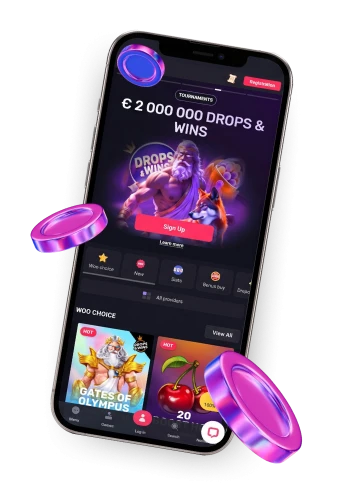
This Woo Casino review looks at what the site’s own Terms actually say about its operator, licence and Canadian eligibility, and distinguishes those statements from independent confirmation. The Terms identify Novatrix SRL as operator and state a Tobique Gaming Commission licence, but neither statement by itself establishes Canadian authorization. The Terms also exclude Ontario and New Brunswick from real-money play, without making any affirmative statement about other provinces.
Operator and licence statements in the Terms
Our WooCasino overview covers the broader product picture; this Woo Casino review instead focuses narrowly on what the Terms can actually establish for a Canadian reader.

According to the current Terms, Novatrix SRL, a company registered in Costa Rica under registration number 3-102-893958, is named as the owner and operator of the site. The same Terms state that Novatrix SRL operates under a Tobique Gaming Commission e-gaming licence, numbered 0000002.
Both statements come directly from the Terms themselves: they describe what the operator claims about its own identity and authorization, not what an independent regulator or corporate registry has separately confirmed. A licence number printed in a document is not the same thing as a verified match against a regulator’s own records, and it does not by itself establish that this licence covers Canadian gambling activity specifically. Treat the operator and licence statements as a starting point for checking, not as a concluded legitimacy finding.
Canadian eligibility under the Terms
Three separate conditions in the Terms matter here, and they should not be collapsed into one blanket statement. First, the minimum age to use the site is 18, unless your province or territory sets a higher legal gambling age, in which case the higher figure applies instead. Second, the Terms permit use only where online gambling is legal, and they place responsibility for checking that local legality on you as the user, rather than confirming it on your behalf. Third, the Terms specifically prohibit real-money play by users from Ontario and New Brunswick.
That third point deserves a careful reading: naming two excluded provinces is not the same as confirming that every other Canadian province is permitted. The Terms simply make no affirmative statement, one way or the other, about jurisdictions outside those two. For a reader located elsewhere in Canada, that absence is an evidence gap rather than a green light, and it is worth checking current provincial gambling rules independently instead of assuming the Terms have already resolved the question.
Withdrawal verification, limits and timing
Before a withdrawal is paid out, the Terms describe a verification step built around standard documents: a photo ID and a proof of address, plus any additional documents the operator decides to request for a particular account. Not every account necessarily submits an identical set of paperwork, since the Terms reserve the right to ask for more depending on the situation. A withdrawal request stays pending for as long as these checks remain open; it does not move into a payable state until verification is complete.
Two further points affect timing and scale. The minimum and maximum withdrawal amounts for a selected payment method depend on that method and are shown when you make the withdrawal request. And once a withdrawal is approved, the Terms describe an aim to process it within 72 hours of that approval, subject to the method used and any outstanding verification. That 72-hour figure is a processing aim stated by the operator, counted from approval — it is not a guarantee of when the funds will actually land in your bank account or payment method, since delivery can depend on factors outside the operator’s own processing.
Reading third-party Woo Casino reviews
External review sites add a further layer of evidence, but each one only covers what it specifically examined. Casino Guru’s review, dated April 2026, identifies Woocasino as owned by Novatrix S.R.L. — the same operator name found in the Terms. That is a useful matching observation, but it is not an independent validation of the licence claim itself or of Canadian authorization.
AskGamblers, separately, describes Woo as accessible through a mobile browser on phones and tablets at woocasino.com. That is a narrow, specific observation about access format. It does not establish that a native app exists in an app store, and it says nothing about whether the site is permitted for real-money play in your particular Canadian province.
When you compare Woo Casino reviews against each other or against the Terms, the useful discipline is to check the date, the specific source, the domain it examined and the exact claim being made, rather than counting how many reviews exist or assuming agreement equals proof.
FAQ
Does the 72-hour processing aim guarantee when a withdrawal will arrive?
No. The Terms describe an aim to process a withdrawal within 72 hours after approval, subject to the payment method and completed verification. That processing aim is not a guarantee of when the funds will actually reach your bank account or payment method, since delivery can depend on factors beyond the operator’s own processing window.
Does a third-party review independently verify Woo’s licence claim?
Not on its own. The Terms state a Tobique Gaming Commission licence claim, and Casino Guru’s April 2026 review separately identifies Novatrix S.R.L. as the owner. That review observation corroborates the operator name but does not independently validate the licence itself or establish that it covers Canadian gambling authorization.
Why might two Woo Casino reviews reach different conclusions?
Reviews can examine different evidence, different dates or different questions entirely. Rather than treating a higher review count or a disagreement as proof either way, check what each source actually looked at — the date, and the specific claim, such as operator identity, access format or terms conditions — and compare only claims that are genuinely comparable.